When you consider the heritage of Durbanville, you may find it interesting to know that Durbanville was called Pampoenkraal, once upon a time. As one of the oldest municipalities in the Western Cape, Pampoenkraal was founded early in the 1800s around a spring, which served mainly as a watering station for travelers. On 2 September 1836, it was renamed D’Urban in honour of Sir Benjamin D’Urban, Governor of the Cape, and in 1886, the name changed to Durbanville, to avoid confusion with Durban.
Durbanville had its own court house, jail and magistrate from the 1870s and became a Magisterial District of Bellville. The court house complex still exists in altered form within the Rust-en-Vrede complex, originally erected in 1850. A village management board was established in 1897 and a municipality in 1901. The first mayor elected was John King.
The village grew rapidly after the turn of the 19th century and a local wagon industry developed. The King Brothers Wagon Works’ used to be South Africa‘s biggest wagon works. At the turn of the century, it employed more than 200 men, which just about accounted for the entire village.
Most of the community service buildings date back to the 18th century, which include the local police station, but here are few special sites worth seeing:
Heritage Sites
Evertsdal Restaurant
This homestead is one of the oldest historically significant buildings in South Africa. The history of this property has been traced back to 1680, 28 years after Jan van Riebeeck had landed in the Cape. One could even say that the history reaches further back to 1659 when a man named Evert who originated from West Guinee arrived in the Cape, was sold into slavery by the Dutch East India Company to Jan van Riebeeck who later set him free. In 1680, the ground on which the house and cellar were built was leased by the Dutch East India Company to Evert. Evertsdal was named after this “Vryburger”.
Address: Cnr Bluegum and Hugenot Ave, Durbanville
Rust-en-Vrede
Rust-en-Vrede was originally built in the 1840’s as a prison and police headquarters, and also served as a magistrate’s court. The complex now houses a Gallery, Clay Museum, various Art Studios and a Whisky library.
It is here that the first Village Management Committee meetings were held. In 1901, with the registering of Durbanville as a Municipality, the first council meetings were also held in the building.
In 1927 the building was sold to Mr Robert John Meneely, a clock maker. During this time the building was converted into 4 semi-detached houses, The Oaks, Ingle Nook, My Vreugd and The Retreat, with the Meneely’s occupying the main section. Mr Meneely was a charming, but eccentric gentleman, who during his retirement years, filled the house with a great number of antique clocks, all ticking away lustily!
After the demise of Mr and Mrs Meneely the Municipality bought the property from the Meneely estate in 1978 and the slow process of restoration began. It was during this time, in 1981, that the Durbanville Cultural Society was officially established. It was decided that, in conjunction with the council, the Durbanville Cultural Society would run the building as an Arts and Culture centre. The building was declared a national monument in 1984.
Address: 10 Wellington Rd, Durbanville
Phone: 021 976 4691
Onze Molen Mill
The ground on which this heritage site now stands, was originally a farm called Johannesfontein. The structure on this heritage site has been reconstructed as the focal point of a building project financed by the Natal Building Society, making it the second completed structure of its kind to have survived the past. It was erected in 1840 and continued to function as such until after the turn of the 20th century when its mechanism and top portion were removed and the remaining structure was converted to a horse mill. The ground has subsequently been turned into a beautiful residential complex, by the same name. The Onze Molen Mill is situated next to Durbanville Racecourse, in Onze Molen Rd, just off High street.
2 Scher Street (Off Gladstone Street)
This late Victorian house (1901) was built for the Churchwarden of the Dutch Reform Church probably by the King Brothers. The veranda has a concave corrugated iron roof with closed ends and a four panel front door with a three paned fanlight. It was purchased in 1954 by the Hebrew Community. It is a private house.
4 Scher Street
Hidden behind a large bush, this Edwardian cottage with a half-hipped corrugated roof with ridge ventilators was originally part of King Brothers Wagon works. It is a private business.
4 Kings Court
Kings Court in Durbanville is possibly the best remaining Edwardian gentleman’s residence in the Northern Suburbs and has been subjected to restoration of high quality by Dr and Mrs Smook. It was declared a National Monument on 12 May 1989.
Kind Court is a double-story and has an iron roof and two projection gabled wings with bargeboard ornamentation and finials. The walls have plaster quoins and window surrounds. There is a double-story verandah and two sides with cast-iron columns, brackets and railings. The windows are Victorian sashes. There are four fireplaces of which two have marble surrounds and two have wooden. It is now business premises and is private.
3 Queen Street
This is a large Edwardian house now having a tile roof to replace the original corrugated iron. The facades are decorated with plaster quoins and window surrounds and the gable ends have shell ornaments. The veranda is supported on classical pillars. It is thought to have been the home of William Baxter.
12 Queen Street
The Skakelhuis is a long building, originally semi-detached houses built at the turn of the 19th/20th century. Incorporating baroque type end gables and smaller gables over the two (original) entrances it has also been extended rearwards to increase space. It is now business premises and is private.
Corner of Queen and Gladstone Streets
This building diagonally opposite the Skakelhuis is of similar age but had been extensively altered in recent times from a semi-detached house into business premises. It is thought that these dwellings were for workers of the Baxter Brothers who owned a large blacksmithing business in Durbanville. It is a private building.
Gladstone Street
This building, now used as a dance studio has a corrugated iron roof at 45° indicating that it may have once been thatched. Note the closed up doorway into the loft space. It was probably part of King Brothers Wagon Works. It is a private business.
20 Oxford Street
Dating from around 1835 this house would have had a thatched roof, since replaced with corrugated iron with a veranda added. The veranda’s supports are modern additions. It currently serves as a Colonial styled pub and restaurant – Speakeasy on Oxford.
22 Oxford Street
This together with No. 20 may be the oldest houses in Durbanville having internal walls of sun baked bricks and may date from 1835. It was damaged in fire and has now been much altered. It currently operates as a coffee shop, called 22 on Oxford.
23 Oxford Street
This building was once owned by the King Brothers. In 1921 it was purchased by George Milne Baxter and known as Baxter House. It was later converted into flats and more recently into business premises. It lies against the Rust-en-vrede Gallery, with gated access to their lovely gardens.
26 -28 Oxford Street
This is a semi-detached house with two gable wings and a veranda in-between. Built in the second half of the 19th century possibly by the Grundlingh family this house has again a steeply pitched roof that may once have been thatched. It also has the distinctive plaster quoining and window surrounds.
27-29 Oxford Street
A semi-detached Victorian cottage with a full-length veranda. The veranda end walls have diamond shaped windows. They have a corrugated iron roof at a steep pitch indicating that it may once have had a thatched roof. There is also a door into the roof space. It may have been built by Francis Porter in 1863 or by William Turner in 1881. It is now one house and is a private dwelling.
27 Church Street
Dating from around the same time as King’s Court on a lot owned by the King Brothers and probably built by the same builder, this house has a particularly fine double storey veranda. It has a fine six panel front door with side and fanlights. Note this house has rusticated quoins at the facade corners. It is a private business premises.
Durbanville Synagogue
Built in 1927 for the Durbanville Jewish community, it was designed by the Town Clerk, T Chenoweth and built by the Baxter Brothers on a piece of ground rented from the Dutch Reformed Church. In 1954 the community purchased the ground and adjoining properties.
Address: 6 Church St, Durbanville
Phone: 021 976 9434
Dutch Reformed Church
Lord Somerset, the Governor of Cape was petitioned by farm owners in 1824 to build this structure for them, which was later declared a National Monument under old NMC legislation on 29 August 1975.
Address: Church St & Weyers Ave, Durbanville
Phone: 021 975 6370
All Saints Complex, Durbanville
The All Saints complex, which includes the original church and the old parsonage, as well as a church hall and a garden of remembrance, dates from 1860 and is closely associated with the history and development of Durbanville. It was declared a National Monument under old NMC legislation on 30 July 1982.
All Saints Anglican Church, Durbanville
The Anglican Church in this Province was established in 1870 when its first Provincial Synod was held in Cape Town. It has grown over the years and now has 25 dioceses, found in the countries of Angola, Lesotho, Swaziland, Mocambique, Namibia, South Africa and the island of St Helena (South Atlantic Island). It has a diverse membership of approximately 34 million people, speaking many languages and representing many cultures and races. In 1989 the Church produced its new Anglican Prayer Book, 1989 which was simultaneously published in 6 languages. Today it is available in 9 of the languages spoken in these regions.
Address: Baxter Street Durbanville
021 976 8016
Sources:
Most of the images of these Heritage sites are from Nigel Amschwand, a mechanical engineer (industrial refrigeration) by profession with a great interest in history and historical archaeology, especially of the Northern Cape. He has published two books on the subject: A Short History of the Onder-Bokkeveld and 1847 Dispossession and Migration.
Information Sources: http://www.theheritageportal.co.za/article/walking-tour-historic-durbanville
Janine de Waal (writer for the above heritage portal link) is an architect and heritage practitioner with local and international experience. She has been involved with teaching and promotes design awareness. Her practice, Janine de Waal Architects, is based in Durbanville.
Parks, Gardens and Nature Reserves
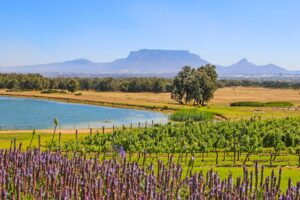
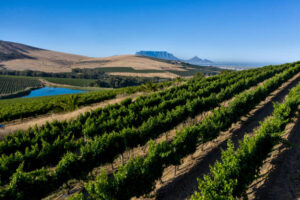
The Durbanville Wine Valley is home to some of the last remaining renosterveld in the Western Cape. Renosterveld forms part of the Cape Floral Kingdom. Today, less than 4% of it remains.
Durbanville Rose Garden
This gorgeous 3,5-hectare piece of land is filled with 500 varietals and 4 500 rose bushes. There is a tea garden, beds of miniatures, beds of medal winners and so much more on offer. It’s a truly beautiful and tranquil place.
The best time for viewing the roses is from October to May when they’re in bloom. The Durbanville Rose Garden houses a collection of approximately 6000 rose bushes which included 500 different species.
Visitors and tourists are invited to enjoy tea served by various charity organisations on Sundays in the garden’s tearoom. The garden is very popular for wedding photographs on Saturday afternoons, in the summer months.
Daily, sunrise to sunset. Free secure parking.
Address: Durban road, and 33 Drakenstein Rd, Durbanville
Time: 6am – 6pm
Cost: Free
Sonstraal Dam
Sonstraal Dam, on Vygeboom Road is the perfect spot for a picnic and a walk, with your family and your pets. There are a few benches around the dam and a foot path, with loads of geese and ducks to view along the way. Just bear in mind that the ducks may not be fed.
Address: 66 Vygeboom Rd, Sonstraal, Cape Town, 7550
The Majik Forest
The Majik Forest provides a touch of greenery and lush beauty to the borders of Bellville and Welgemoed, just a 5 minute drive from both Tyger Valley Shopping Centre and Willowbridge Mall. It’s a nature lover’s paradise, offering mountain biking trails, walking and hiking trails, picnic spots, a dam and a place to take your dogs.
Whilst certain sections of the park are off-limits to bicycles, you can take your bike along, but keep an eye out for no cycling signs and stick to your designated paths/routes. (For example, apparently, no cycling is permitted on the walkway between the houses and dam… something not everyone seems to be aware of.)
Due to its natural beauty, Majik Forest is often used for family-, couple- and wedding-photo shoots.
Address: Cnr Van Riebeeckshof Road and Jip de Jager Road
- A vehicle
- Smartphone with camera
- Internet access
Cost:
R200 per person, covering entry, activities, clues, maps, and road snacks. Optional tastings,
meals, and beverages are at your own expense.
Bookings
Secure your spot two weeks in advance! Contact Janine Tassi at What’s on in Durbanville –
Call 082 925 8438, email janine@whatsonwc.co.za, or WhatsApp.